Maternity Leave Philippines: Days, SSS Benefits and Calculator
Check my SSS maternity benefit ↓Takeaway
Live childbirth has 105 calendar days of maternity leave, or 120 for a qualified solo parent. Miscarriage, emergency termination of pregnancy and stillbirth have 60 days. SSS cash benefits have a separate contribution test: at least three qualifying paid months in the twelve months before the excluded semester. Choose the contingency month below to see that window and estimate the benefit.
SSS maternity benefit calculator
Start with the delivery or pregnancy-termination month. The qualifying months appear below. This month is an example; replace it with yours.
Exclude Jul 2026–Dec 2026. Count only qualifying contributions paid before 2026-07-01.
Enter your twelve-month contribution record
Use the Regular SSS monthly salary credit (MSC), not your monthly contribution payment or total credit including Pension Booster. Enter 0 or leave blank for a month without a qualifying contribution. Positive entries must match your actual posted record.
Optional: allocation and leave dates
Check your qualifying contributions
- Positive qualifying-month entries
- 0 of 12
- Six highest MSCs, zero-filled if needed
- ₱0.00 + ₱0.00 + ₱0.00 + ₱0.00 + ₱0.00 + ₱0.00
- Selected MSC total ÷ 180
- ₱0.00 ÷ 180
- Average daily salary credit
- ₱0.00
- Mother’s compensable days
- 105 − 0 = 105
At least three qualifying paid months are required. This entered record has fewer than three. Check posting or employer-remittance issues with SSS.
This calculates the SSS portion from your entries. It does not include employer salary differential, overlapping claims, sickness-benefit overlap or SSS approval. Government full-pay entitlement uses agency rules. SSS computation rules, checked 11 October 2026.
Open My.SSS and check your contribution record · Check employer full pay
For Philippine maternity-leave planning and Regular SSS cash-benefit estimates from 2021 onward. A cash-benefit estimate is not SSS approval or an employer full-pay calculation. The guide separately explains government employment, self-employed members, allocation, employer exemptions and disputed remittances.
In this guide
What is maternity leave? Ano ang maternity leave?
Maternity leave is time away from work for childbirth or pregnancy loss under the applicable law. The leave period, SSS cash benefit and employer salary differential are related, but they are different things. A notification form does not guarantee a benefit payment.
Ang maternity leave ay panahon ng pahinga mula sa trabaho para sa panganganak o qualifying pregnancy loss. May sahod ba pag naka-maternity leave? Para sa covered private employee, ihiwalay ang SSS benefit at employer salary differential; para sa self-employed o voluntary member, SSS benefit ang kinukuwenta. Hindi sapat ang monthly salary lang para malaman ang halaga.
How many maternity leave days: normal, caesarean or miscarriage?
Scroll across to see all columns.
| Contingency | Leave / benefit period | Important condition |
|---|---|---|
| Live childbirth, normal or caesarean | 105 calendar days | Same period for normal and CS delivery. |
| Live childbirth, qualified solo parent | 120 calendar days | Additional 15 days; meet solo-parent requirements and documents. |
| Miscarriage, ETP or stillbirth | 60 calendar days | Use the medical/documentary requirements for the actual case. |
| Optional extension after live childbirth | Up to 30 days without pay | Written notice at least 45 days before paid leave ends, except medical emergency. |
Weekends and holidays count. Use the actual approved start date and count it as day 1. Do not count only working days or replace 105 days with three calendar months. The benefit can combine prenatal and postnatal leave, but at least 60 days must be postnatal.
Twins or triplets do not multiply the maternity benefit. The law is not limited to the first four pregnancies; each qualifying instance is considered. Being unmarried does not remove entitlement. Allocation to an employed father or eligible caregiver reduces the mother’s leave credits and SSS cash benefit, as explained below.
For example, 105 days starting 1 October 2026 end on 13 January 2027 when the first day is counted. The next calendar day is 14 January; the actual next working day depends on the schedule and approved extension. Use the optional calendar in the estimator for your dates.
Which months qualify for SSS maternity benefits?
Figure 1: October 2026 contingency
Use these twelve months
- Jul 2025Qualifying window
- Aug 2025Qualifying window
- Sep 2025Qualifying window
- Oct 2025Qualifying window
- Nov 2025Qualifying window
- Dec 2025Qualifying window
- Jan 2026Qualifying window
- Feb 2026Qualifying window
- Mar 2026Qualifying window
- Apr 2026Qualifying window
- May 2026Qualifying window
- Jun 2026Qualifying window
Exclude these two quarters
- Jul 2026Excluded semester
- Aug 2026Excluded semester
- Sep 2026Excluded semester
- Oct 2026Excluded semester
- Nov 2026Excluded semester
- Dec 2026Excluded semester
First identify the quarter containing childbirth, miscarriage or ETP. Exclude that quarter and the immediately previous quarter: together they are the semester of contingency. Then take the twelve months ending immediately before that excluded semester.
At least three monthly contributions must fall in that twelve-month window. SSS considers only contributions paid before the semester of contingency. Paying within or after the excluded semester does not fix the benefit calculation by itself. Check the posted contribution record and payment timing, not just the month printed on a receipt.
For an October–December 2026 contingency, the excluded semester is July–December 2026. The qualifying window is July 2025–June 2026, with qualifying contributions paid before 1 July 2026. For January–March 2027, exclude October 2026–March 2027 and examine October 2025–September 2026.
If the actual delivery moves into another quarter, recalculate. An expected delivery month is only a planning estimate. A contribution from outside the correct window is not counted just because it is a higher amount.
How to compute SSS maternity benefits
Figure 2: from six salary credits to ₱70,000
Assume six qualifying credits of ₱20,000, live childbirth, no allocation and no overlapping claim.
- Selected credit 1₱20,000
- Selected credit 2₱20,000
- Selected credit 3₱20,000
- Selected credit 4₱20,000
- Selected credit 5₱20,000
- Selected credit 6₱20,000
- Six credits: ₱20,000 × 6
- ₱120,000
- Daily allowance: ₱120,000 ÷ 180
- ₱666.666…
- Multiply unrounded daily credit by 105
- ₱70,000
Read the Regular SSS monthly salary credits, or MSCs, for the qualifying window. MSC is the benefit base, not the contribution payment deducted from your payslip. The Regular SSS benefit calculation is capped at ₱20,000 MSC; Pension Booster/WISP credits above that ceiling do not increase this maternity allowance.
Add the six highest qualifying MSCs. Divide that sum by 180 to obtain the average daily salary credit. Multiply by 105, 120 or 60 compensable days as applicable. If eligible allocated days apply, reduce the mother’s compensable days accordingly. Keep full precision until the final peso amount.
If you have only three, four or five qualifying paid months, use those credits and zero for the remaining selected months. The divisor remains 180. Do not divide by 90 merely because only three months were paid. The estimator handles this zero-fill and shows every step.
How much can SSS maternity pay? Why is it below ₱70,000?
Scroll across to see all columns.
| Unallocated qualifying case | Six credits at Regular MSC ceiling | Three credits at Regular MSC ceiling |
|---|---|---|
| Live childbirth, 105 days | ₱70,000 | ₱35,000 |
| Qualified solo parent, 120 days | ₱80,000 | ₱40,000 |
| Miscarriage/ETP/stillbirth, 60 days | ₱40,000 | ₱20,000 |
These are current Regular SSS ceiling examples, not an amount guaranteed to every member. Three credits at ₱20,000 total ₱60,000; ₱60,000 ÷ 180 × 105 = ₱35,000. Six at ₱12,000 total ₱72,000; ₱72,000 ÷ 180 × 105 = ₱42,000. Lower credits, missing months, late payment, allocation or overlapping claims can change the amount.
The SSS portion can be lower than the employee’s full-pay entitlement. Raising a recent contribution after the qualifying window has closed does not automatically raise an earlier maternity claim. Do not confuse a 2025 total contribution-credit ceiling of ₱35,000 with the Regular SSS maternity ceiling of ₱20,000.
Who pays: SSS or the employer? Check salary differential
For a covered private-sector employee, full maternity pay consists of the SSS cash benefit and the salary differential borne by the employer, subject to a valid employer exemption. The SSS amount is not automatically an extra payment on top of the same full salary already paid. Ask for separate lines and avoid counting the SSS portion twice.
Request the full-pay basis for the actual leave period, relevant regular wages and allowances, employee mandatory contribution shares, SSS amount and remaining employer differential. Confirm the payroll computation under DOLE Department Advisory 01-19 as amended; do not substitute a casual monthly-salary estimate for that reconciliation.
For a simple arithmetic comparison, if payroll confirms ₱100,000 as the full-pay amount after applicable employee contribution shares and the SSS portion is ₱70,000, the remaining differential is ₱30,000. Those are assumed confirmed figures, not a universal salary divisor or a finding about your employer’s liability.
The employer generally advances the maternity benefit within 30 days from filing the maternity leave application. SSS reimbursement follows the employer’s documented advance; it is not a blanket reason to delay payment to the employee. Keep the application date, approval and advance-payment evidence.
Can a small employer refuse the salary differential?
RA 11210 provides exemption categories, including distressed establishments, specified establishments with not more than ten workers, qualifying micro-business enterprises with assets not exceeding ₱3 million, and employers already providing similar or better benefits. These categories are subject to the required justification and DOLE approval; small headcount alone is not proof of an exemption.
Ask for the applicable exemption category, the annual submission and the DOLE approval covering the relevant period. SSS’s published guidance says the application is submitted in the first quarter of each year. A claimed salary-differential exemption does not itself remove the member’s SSS cash benefit.
Notify HR and SSS before making a benefit claim
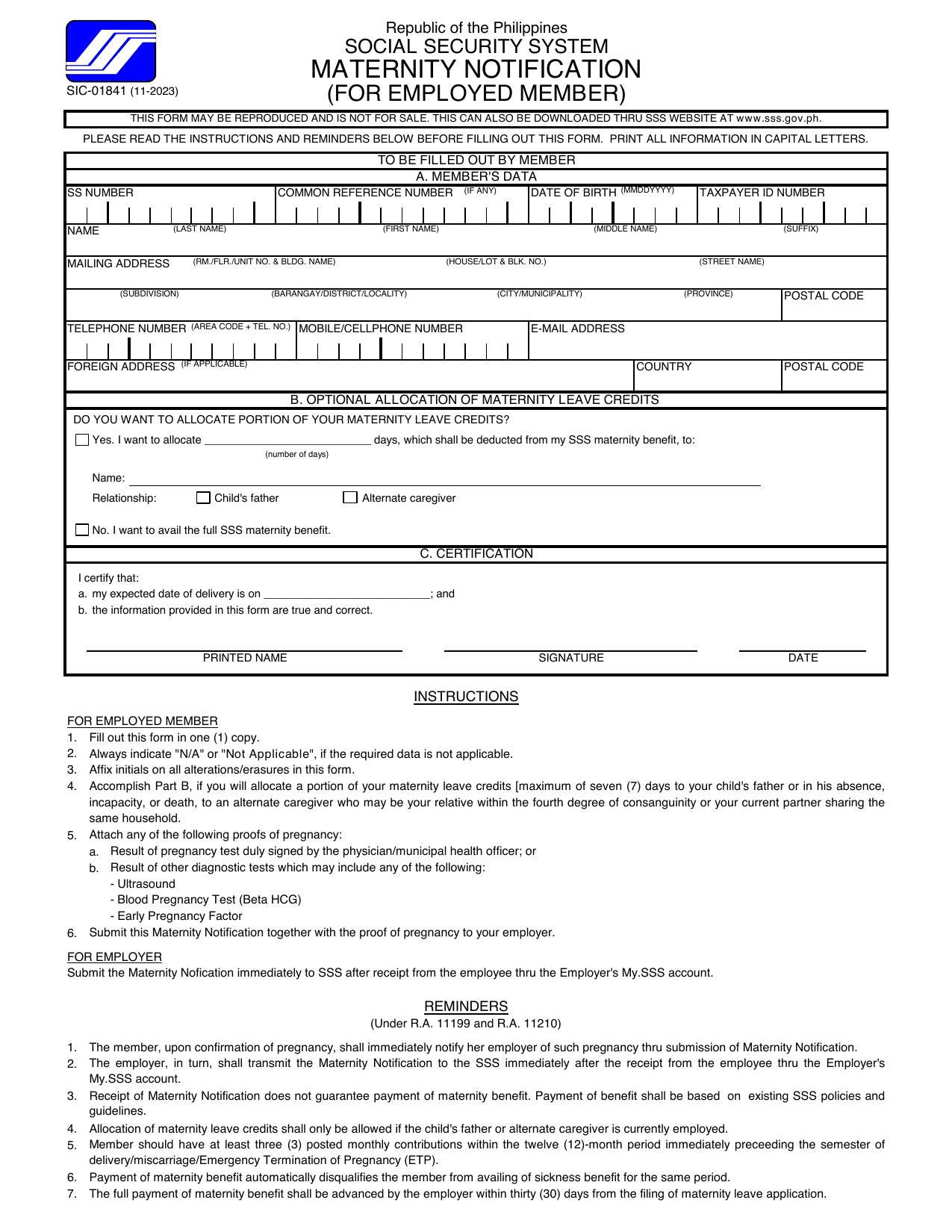
Looking for “Maternity 1”? Use the current SSS Maternity Notification for employed members. If employed, inform the employer of the confirmed pregnancy and expected delivery. Use the official Maternity Notification and the required proof of pregnancy. The employer transmits the notification through its My.SSS account; this is different from the later reimbursement application.
On the blank form below, Part A records member details. Part B records optional allocation of up to seven days; the form states that allocated days are deducted from the SSS benefit. Part C certifies the expected delivery date. Submit the completed form through your employer’s process; do not put medical records or an SS number into this website.
Self-employed, voluntary, non-working-spouse and OFW members notify SSS directly through the permitted member channels. Check the registered email and member record before filing. Notification is a prerequisite process, not a payment approval or a substitute for contribution qualification.
Maternity claim requirements: birth, loss and solo parent
Scroll across to see all columns.
| Claim situation | Documents to check | Timing / condition |
|---|---|---|
| Live childbirth | Registered Certificate of Live Birth and corresponding receipt/acknowledgment; applicable foreign birth report for birth abroad. | SSS accepts qualifying LCR documents within six months; PSA-issued documents beyond six months. |
| Stillbirth / fetal death | Certificate of Fetal Death with the applicable receipt/acknowledgment. | Use the LCR/PSA and timing rules for the case. |
| Miscarriage, ETP, ectopic pregnancy or hydatidiform mole | Proof of pregnancy, proof of termination and a qualifying medical document signed by a physician. | Use the current SSS checklist; one generic medical certificate alone may not cover all required categories. |
| Qualified solo parent | Valid LGU Solo Parent ID or qualifying eligibility certification/e-certification. | SSS has delivery-date validity rules and an exception for a first-time solo parent’s document issued within six months. |
| Already separated from employment | Relevant separation certification and no-advance-payment information or applicable alternative process. | Requirements depend on when the contingency occurred and the stated separation circumstances. |
The current SSS benefit page lists the acceptable alternatives and special cases in full. Upload readable colored scans of the original or certified true copy as required, including associated receipts. Medical documents need the required physician details. Foreign documents may need an English translation; do not invent a universal apostille requirement.
A pregnancy certificate helps establish pregnancy for notification. Claiming after the contingency also needs birth or pregnancy-termination evidence for that case. Keep medical files private and use only the official SSS submission or employer’s approved process.
How to apply online: MBA, MBRA and DAEM
For the standard online employer MBRA process, the employee confirms the advance-payment receipt through the member process within seven working days of SSS’s email notification. Denial or no response can cause rejection/refiling; special cases have different requirements. Read the actual SSS notice rather than treating employer submission as a completed reimbursement.
Applications may be filed within ten years of the contingency under SSS’s current guidance. This claim period does not remove the pregnancy-notification requirement, qualifying-contribution rules or the employer’s advance-payment duty. Earlier cases use the rules applicable to their dates.
Follow the member portal steps → · Employer MBRA workflow →
- Before the contingency: confirm notification and the correct qualifying contribution record.
- Check the approved disbursement account in My.SSS DAEM, not just a bank number typed into an application.
- For the standard employed-member case, the employer advances the benefit and applies for reimbursement using MBRA.
- For eligible self-employed, voluntary, non-working-spouse, OFW or separated-member cases, follow the member MBA process and case-specific employer certification requirements.
- After childbirth or loss, prepare the applicable documents, enter the actual contingency details and submit through the correct account.
- Save the reference and check claim status and disbursement separately.
How long does payment take? Check the exact status
There is no single guaranteed bank-credit date for every claim. Distinguish the employer’s 30-day advance obligation from SSS evaluation, approval, reimbursement and actual account credit. A portal status abbreviation is not enough to establish that money reached your account.
If you see a status such as “BPR,” open the transaction details and compare the SSS disbursement notice with the receiving account. Use the full status and reference details shown by SSS to establish the next step. Keep the claim reference, submission date and any deficiency notice.
If crediting fails, SSS instructs the member/employer to correct or enroll a disbursement account in DAEM and request re-disbursement through the appropriate module. If documents are rejected, address the stated deficiency for that case rather than submitting the same unreadable file repeatedly.
Maternity leave for men: allocation is different from paternity leave
The mother may allocate up to seven leave days to the child’s father, whether married or not, or an eligible alternate caregiver in the circumstances provided by law. Give the required written notice to the relevant employers. The current SSS notification form says allocation is for an employed father/caregiver and deducts those days from the mother’s benefit.
For the six-₱20,000-credit example, allocating seven of 105 days leaves 98 days for the mother: ₱120,000 ÷ 180 × 98 = ₱65,333.33. Payment or leave for the receiving father/caregiver is a separate employer matter; the estimator does not add it to the mother’s amount.
Allocation is unavailable for miscarriage or ETP. It is also separate from statutory paternity leave under RA 8187, which has its own conditions. Do not apply the married-father paternity rule to every maternity allocation, or describe allocation as an automatic extra seven days for the mother.
When to start, how to extend and when to return
Agree the prenatal start and expected return with HR, then update the plan for the actual contingency date. Leave must be continuous and cannot be deferred for later use. Preserve at least 60 days of postnatal leave; a calendar calculation is not medical advice or approval of a leave schedule.
After live childbirth, an optional extension of up to 30 days without pay requires written notice at least 45 days before paid maternity leave ends. A medical emergency permits subsequent notice under the law. The optional unpaid extension does not automatically increase the SSS cash benefit.
A concise request can state: “Please confirm my maternity leave from [start date], the expected contingency date, the approved paid period and expected return. Please show the SSS contribution window, benefit estimate, employer differential and payment schedule separately. I will update the actual contingency date and submit the required documents.” Use your real dates and the approved HR submission channel.
Government employees, new hires and self-employed members
Government employees covered by RA 11210 have statutory maternity leave with agency full pay, regardless of employment status and length of service under the law. Do not apply the private employee SSS calculator as a calculation of an agency’s full-pay entitlement. A job-order or contract-of-service arrangement needs its own contract and coverage check; the workplace name does not by itself establish employee status.
New or probationary private employees should not be told that maternity leave automatically requires a year at the current employer. The SSS cash benefit uses the qualifying contribution history, which can include eligible earlier-employer contributions in the proper period. Full-pay obligations, notice and actual employment facts still need checking.
Eligible self-employed, voluntary, non-working-spouse and OFW members receive the SSS benefit; the estimator does not invent an employer salary differential where there is no covered employment. “Pag-IBIG maternity requirements” should not be substituted for an SSS maternity claim: verify each agency’s separate savings, loan or health program with that agency.
What if I resign, am dismissed or my employer did not remit?
A maternity-leave claim and a final-pay claim are separate questions. RA 11210 addresses a contingency within 15 calendar days after termination of service, and has a distinct rule where a pregnant employee was terminated without just cause. SSS also has separated-member filing and certification procedures. Do not infer the entire employer liability from a portal contribution count.
If the employer failed to remit required contributions or transmit notification, the law contains an employer-damages provision. Preserve payslips, contribution deductions, notification proof and the employment dates, then ask SSS and DOLE to assess the actual case. A zero or ineligible estimate based on an incomplete record is not proof that the employee has no remedy.
Maternity leave cannot itself be used as a basis for demotion or termination under RA 11210. A pending administrative case does not remove the statutory maternity benefits. A disputed dismissal still needs the facts and applicable procedure; this calculator does not adjudicate it.
Is maternity pay taxable? Does it affect 13th-month pay?
SSS maternity benefits and the statutory maternity salary differential are exempt from income and withholding tax under BIR RMC 105-2019. Keep ordinary pay or unrelated allowances separate, rather than treating every amount on a maternity-period payslip as exempt.
DOLE’s monetary-benefits handbook states that the salary differential is included in basic salary for the rank-and-file employee’s 13th-month computation. The SSS cash benefit is a different payment; do not add the whole benefit as ordinary basic salary or automatically mark every maternity month as zero. Ask payroll for the earned-basic and salary-differential ledger used in the annual calculation.
Check maternity tax treatment → · Compute the 13th-month amount →
Other maternity questions
| Question | Answer |
|---|---|
| Can I claim after giving birth? | The current claim period is ten years, but notification, contribution timing and case-specific documents still apply. |
| Do only three recent contributions qualify? | They must be in the twelve months before the excluded semester and paid before it. Contributions in the latest three months can be outside that window. |
| Is caesarean leave longer than normal delivery? | For current live childbirth, both use 105 days, or 120 for a qualified solo parent. Historical pre-11 March 2019 rules differ. |
| Are 2022 or 2023 examples still usable? | Use the actual contingency window, credits, contribution timing and documents applicable to that claim. Do not apply the latest contribution schedule retrospectively. |
| Can maternity and sickness cash benefits cover the same days? | SSS bars sickness-benefit recovery for the same period covered by maternity benefits. Overlapping maternity claims also have adjustment rules. |
| Does unmarried mean solo parent automatically? | No. Unmarried status does not remove ordinary maternity entitlement, but the additional 15 days needs qualification and the required solo-parent documents. |
Sources
- Republic Act 11210: Expanded Maternity Leave LawSections 3, 5, 6 and 9
- SSS: Maternity BenefitCurrent qualifying period, Regular MSC ceiling, calculation, allocation, claims and documentary requirements; checked 11 October 2026
- DOLE: salary differential guidelinesDepartment Advisory 01-19 as amended by 01-A-19; payroll reconciliation and exemptions
- SSS Maternity Notification, SIC-01841Official November 2023 form currently linked by SSS; Parts A–C, instructions and allocation deduction
- SSS Circular 2021-004: online MBA and MBRAMember/employer online applications and seven-working-day employee confirmation
- SSS Circulars: separated-employee certificationCircular 2023-011 and current maternity-benefit page for case-specific certification
- Republic Act 8187: Paternity Leave ActSections 2, 3 and 6
- BIR RMC 105-2019: maternity salary differentialBIR circular hosted by Philippine Commission on Women; income and withholding-tax exemption
- DOLE Handbook on Workers' Statutory Monetary Benefits, 2024Coverage chart, guide computations table and chapters on holiday, premium, overtime, night shift, service charge, leave, 13th-month, separation and retirement pay; 2024 edition
General educational information. Eligibility, company agreements and the facts of a dispute can change the answer. This guide has not been reviewed by a Philippine labor lawyer. Ask DOLE or a qualified professional about a contested entitlement.