Overtime Pay Calculator Philippines
Compute my overtime ↓Takeaway
For covered employees, overtime on an ordinary workday is paid at least your hourly basic rate × 1.25 × OT hours. Rest-day and holiday OT use higher rates. Add 10% of the applicable OT rate only for hours worked between 10 p.m. and 6 a.m.
Compute your overtime pay
Start with your payroll basic rate and the hours worked after your normal eight-hour day. The starting numbers are a sample: ₱100 per hour, two OT hours, one at night.
Help me count the hours
Enter only the overtime period, without unpaid breaks. If it crosses midnight, the end time is on the following day. Split different holiday/rest-day rates into separate calculations.
Monthly-paid? Ask payroll for your applicable hourly rate or daily-rate divisor. A fixed divisor of 26 is not correct for every employment arrangement.
Your overtime payment
₱262.50For the OT hours entered. Your first eight hours and payroll deductions are separate.
- Hourly basic rate
- ₱100.00
- OT multiplier
- × 1.25
- OT pay before night differential
- ₱250.00
- Night differential on OT
- ₱12.50
₱125.00 per OT hour; ₱137.50 per qualifying night OT hour.
Checking a complete payslip? Use the salary tax calculator. See night differential for night hours within your normal shift.
General statutory minimum rates for covered private-sector workers. Formulas: Labor Code Article 87 and the DOLE 2024 monetary benefits handbook, checked 11 October 2026. Better company rates and valid alternative work arrangements need separate checks. Calculations stay in your browser.
Standard private-sector hours-of-work rules. This tool computes payment for overtime hours only, not your full day’s pay, tax or statutory contributions. Confirm coverage, compensable hours and any more favorable agreement before using the estimate.
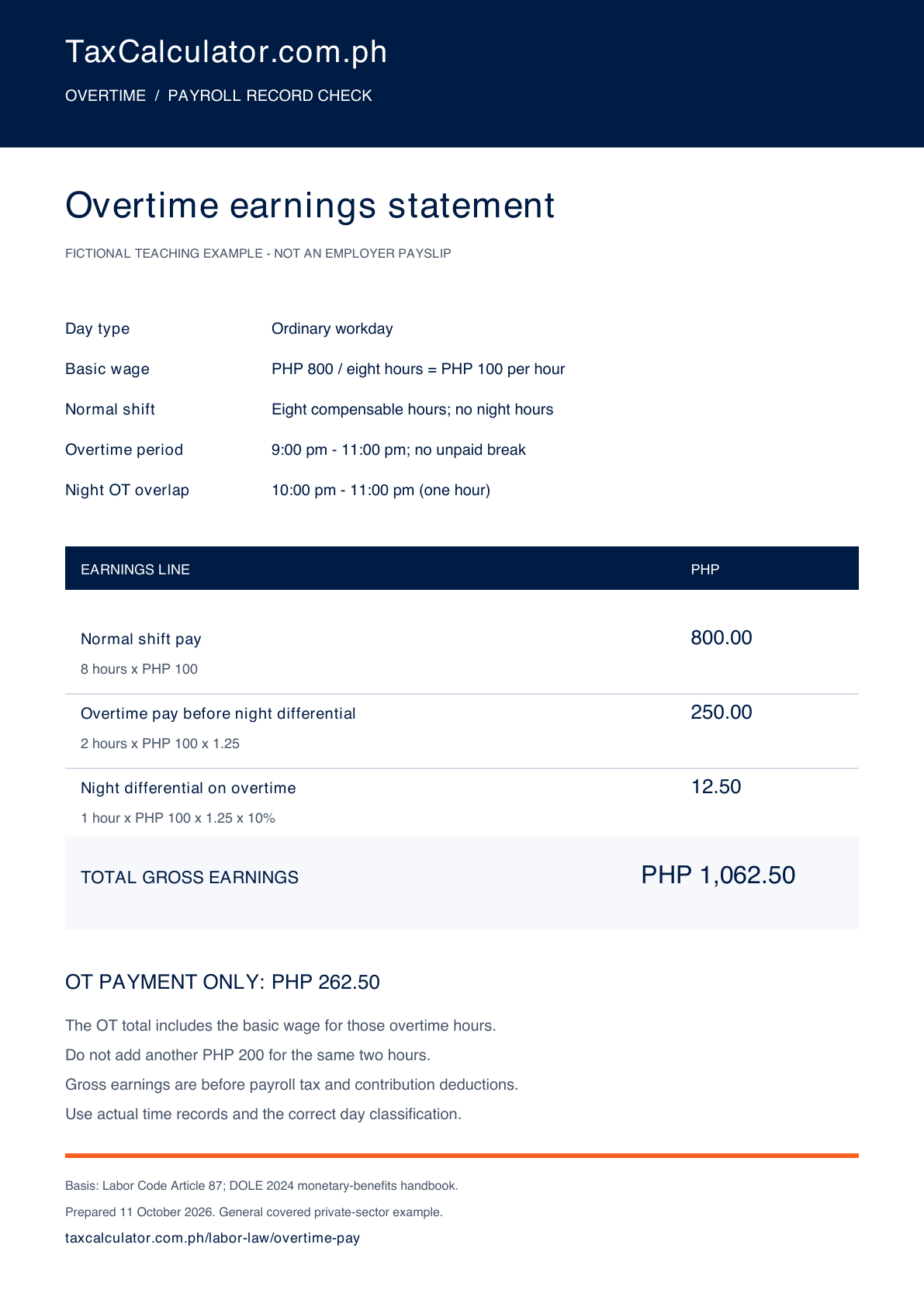
See how overtime appears in a payroll breakdown
Here is a sample with eight normal hours and overtime from 9–11 p.m. Compare the three earnings lines, rather than just the total.
In this guide
How to compute overtime pay in three steps
Find the applicable basic hourly wage, identify the type of day, then multiply by the overtime hours actually worked. For an eight-hour daily basic wage, hourly rate = daily basic wage ÷ 8. For a monthly wage, get the payroll daily-rate divisor or confirmed hourly rate; working days, paid rest days and the salary arrangement can change the conversion.
Ordinary-day OT pay = hourly basic rate × 1.25 × overtime hours. The 1.25 already includes the basic wage for the overtime hour plus the 25% premium. Do not add that hour’s basic wage again. On a rest day or holiday, use the corresponding multiplier in the table below.
At an hourly basic rate of ₱100, two ordinary-day overtime hours are ₱250. Add this to the separately computed pay for the normal shift when checking total earnings. It is not a ₱250 premium added on top of another ₱200 for the same OT hours.
DOLE overtime rates by type of day
Scroll across to see all columns.
| Day worked | First eight hours: basic rate × | Each OT hour: basic rate × | OT at night: basic rate × |
|---|---|---|---|
| Ordinary workday / special working day | 1.00 | 1.25 | 1.375 |
| Scheduled rest day | 1.30 | 1.69 | 1.859 |
| Special non-working day | 1.30 | 1.69 | 1.859 |
| Special non-working + rest day | 1.50 | 1.95 | 2.145 |
| Regular holiday | 2.00 | 2.60 | 2.86 |
| Regular holiday + rest day | 2.60 | 3.38 | 3.718 |
| Two regular holidays on one date | 3.00 | 3.90 | 4.29 |
| Two regular holidays + rest day | 3.90 | 5.07 | 5.577 |
These are general minimum factors for covered workers, based on the Labor Code and the DOLE 2024 handbook; checked 11 October 2026. The last column includes the 10% night differential. A company or collective agreement may provide higher rates.
Choose the day according to the official holiday declaration and your scheduled rest day. A Sunday is not automatically your rest day. A special working day normally uses ordinary-workday rules. A special non-working day and a regular holiday use different rates.
Rest-day OT is 1.30 × 1.30 = 1.69 of the ordinary hourly wage. Regular-holiday OT is 2.00 × 1.30 = 2.60. If that regular holiday is also your rest day, 2.00 × 1.30 × 1.30 = 3.38. Do not apply 1.25 to these already-adjusted holiday rates; the relevant OT addition is 30%.
How to compute overtime with night differential
One OT period, two hourly rates
- 9–10 p.m.₱125.00Ordinary OT: ₱100 × 1.25
- 10–11 p.m.₱137.50Night OT: ₱100 × 1.25 × 1.10
Example: 9 p.m. to 11 p.m. after an ordinary shift
Assume a covered employee, a confirmed ₱100 basic hourly rate, and two overtime hours with no unpaid break. Only 10 p.m. to 11 p.m. qualifies for night differential.
- OT before night differential: ₱100 × 1.25 × 2
- ₱250.00
- Night differential: ₱100 × 1.25 × 10% × 1
- ₱12.50
Count only the overtime hours inside 10 p.m. to 6 a.m. If OT runs from 9 p.m. to 11 p.m., there are two overtime hours but only one night OT hour. Multiply the applicable OT hourly rate by 10% for that one hour, then add it to the OT pay.
Night differential on OT = basic hourly rate × OT multiplier × 0.10 × qualifying night OT hours. Total OT pay = basic hourly rate × OT multiplier × all OT hours + night differential on those OT hours. The helper in the calculator counts this overlap for a single continuous period without unpaid breaks.
For an overnight period, the end time is treated as the next day. Separate unpaid breaks. If the day’s classification changes at midnight, calculate each relevant segment separately using the appropriate classification and your established workday; do not treat one selected rate as a universal answer for a mixed-date shift.
Rest-day and holiday overtime examples
For two overtime hours on your scheduled rest day at ₱100 basic hourly wage, the result is ₱100 × 1.69 × 2 = ₱338. If both hours fall within the night window, add ₱33.80 night differential for ₱371.80 total overtime pay.
For two OT hours on a regular holiday that is also your rest day, ₱100 × 3.38 × 2 = ₱676. If both qualify for night differential, add ₱67.60 for ₱743.60. The first eight hours’ holiday/rest-day payment remains a separate line.
If your shift is on a special non-working day that is also a rest day, two OT hours at ₱100 are ₱390 before night differential. Do not substitute the regular-holiday rate just because payroll calls both dates “holidays.”
What counts as overtime? Minutes, breaks and part-time work
Under the general rule, overtime is work beyond eight hours in a day. Merely being on site does not by itself establish every minute as compensable work. The actual work, required waiting, meal periods and interruptions need to be checked against hours-worked rules and the records.
Enter minutes as fractions of an hour: 30 minutes = 0.5, 45 minutes = 0.75, and one hour 30 minutes = 1.5. Keep precision through the calculation and round the final displayed amount to centavos. Compare the payroll rounding policy if there is a small difference.
A part-time employee does not automatically earn statutory overtime after a four-hour scheduled shift; the general statutory threshold is beyond eight hours, unless a more favorable agreement pays an earlier premium. For example, work from a fifth through an eighth compensable hour can still be ordinary hours under the general rule.
Who is entitled to overtime pay?
Check the legal coverage before treating the multiplier as an entitlement. The hours-of-work provisions exclude categories including managerial employees, qualifying members of managerial staff and qualifying field personnel, as well as other categories in the Labor Code and implementing rules. Government employment and domestic work require their own rules.
A job title does not settle the issue. Actual duties, management authority, supervision and whether hours can reasonably be determined matter. Ask payroll for the specific exemption and its basis if a “supervisor,” remote worker or salesperson is classified as exempt.
Night differential has its own coverage exclusions, including certain retail or service establishments regularly employing not more than five workers. That threshold should not be copied into a blanket overtime exemption. Likewise, holiday-pay coverage has its own rules.
What if overtime was not pre-approved?
Keep the attendance record, task instructions and evidence that the employer required or permitted the extra work. An approval policy is relevant to a dispute, but a missing form does not by itself answer whether actual compensable work was performed with the employer’s knowledge. Request the reason for any rejection in writing.
The Labor Code recognizes specified circumstances in which emergency overtime can be required. Outside those grounds, do not assume that every employer request creates an unlimited right to demand extra hours. The circumstances, consent and applicable agreement matter.
Is mandatory overtime legal? Is there a maximum?
Article 89 allows required emergency overtime in specified cases: declared war or emergency; preventing loss of life or property in a disaster; urgent equipment work to avoid serious damage; protecting perishable goods; or finishing work necessary to prevent serious obstruction to operations. The required overtime must still be paid. A routine preference to work longer is not automatically one of those grounds.
Articles 83 and 87 establish the normal eight-hour day and payment for overtime; they do not give a universal four-hour daily OT cap. A company schedule, worker category, health and safety requirement or specific arrangement may impose other limits. Do not read the calculator’s input limit as a legal maximum.
If asked to work compulsory overtime, request the reason and schedule and keep a copy. For an unsafe or contested instruction, seek DOLE guidance on your actual circumstances.
A simple overtime request and payroll follow-up
To request approval: “Please approve overtime on [date] from [start] to [end] to complete [specific task and reason]. I expect [number] compensable hours, including [number] between 10 p.m. and 6 a.m. Please confirm the day classification and applicable rate.” Use the real reason; do not copy an invented emergency.
To query payment: “Please show the OT hourly rate, day multiplier, credited hours and night differential for [dates]. My time records show [details], while the payslip lists [amount]. I have attached the relevant approval and attendance record.”
Paano mag-compute ng overtime pay? Kunin ang basic hourly rate, piliin ang tamang uri ng araw, at i-multiply sa overtime hours. Sa ordinaryong araw, hourly rate × 1.25 × OT hours. Ihiwalay ang OT hours na pasok sa 10 p.m.–6 a.m. bago idagdag ang night differential.
Is the overtime rate different in Manila, Cebu or Bulacan?
The general statutory multipliers shown here are not a separate peso rate for each city. Your applicable basic wage can differ by region, sector and wage order. Use your confirmed actual wage and the wage order applicable on the work date, rather than a salary example from another region.
For Manila, Cebu, Bulacan, Pampanga or another location, check the minimum-wage guide and the official regional wage order. The calculator accepts your actual rate; it does not assume a current regional daily wage.
Check minimum-wage coverage and regional rates →
Is overtime included in 13th-month pay?
Overtime pay is generally excluded from the statutory basic-salary base for 13th-month computation, unless it has been treated as part of basic salary through the applicable agreement, policy or practice. Do not add all gross payslip earnings into the basic-salary total without checking which components qualify.
Can undertime or offset leave replace overtime pay?
Article 88 prohibits offsetting undertime on one day against overtime on another day. If you were late on Monday and worked overtime on Tuesday, record each day separately rather than deducting Monday’s shortage from Tuesday’s OT hours.
A valid compressed-workweek arrangement raises a different question about the normal daily schedule. Ask for the written arrangement and applicable DOLE guidance before treating every scheduled ninth or tenth hour as statutory overtime. This calculator assumes the standard eight-hour threshold and does not evaluate the validity of a compressed schedule.
Is overtime pay taxable?
For an ordinary taxable employee, overtime generally forms part of taxable compensation. Qualifying overtime of a statutory minimum wage earner has a specific tax exemption. Do not decide minimum-wage-earner status from a salary figure alone or apply the exemption to everyone with a low tax bill.
Use the taxable-income reference to classify the payment, and the salary tax calculator to estimate deductions on total taxable compensation. The result above is gross OT earnings, so it will not necessarily equal the extra amount deposited in your bank account.
Check which payments are taxable →
How to check an overtime payslip
Download your calculator breakdown and compare it with the payroll OT line. If the figures differ, ask for the hourly rate, multiplier, credited hours and night-hour calculation. If the discrepancy remains unresolved, seek DOLE assistance with the records rather than relying on the net payslip alone.
- Match each date with the official day classification and your rest-day schedule.
- Confirm your basic hourly rate and any monthly-to-daily divisor.
- Compare compensable OT hours with time records and approvals.
- Separate normal-shift night hours from night OT hours.
- Check that the base wage for the same overtime hour was not counted twice.
- Look for any better contractual or company premium.
- Keep deductions and take-home pay separate from gross OT earnings.
Other overtime questions
| Question | Answer |
|---|---|
| How much is one hour of overtime? | On an ordinary day, at least 1.25 times the covered employee’s basic hourly rate; a ₱100 rate gives ₱125. |
| How do I compute overtime from a monthly salary? | Obtain the applicable daily-rate divisor or payroll hourly rate. Do not assume all monthly salaries use 26 days. |
| Is the first eight hours’ pay included in the calculator? | No. The result covers only the overtime hours you entered, including their basic-hour component. |
| Can I use this for 2023 or an older payslip? | The general multiplier method can help, but use the actual historical wage, day classification and applicable rules or agreement. The page does not reconstruct historical payroll. |
| Is OT counted over 40 hours in a week? | The general Philippine rule here is the daily eight-hour threshold; do not substitute a foreign weekly threshold. |
Sources
- DOLE: Book III, Conditions of EmploymentArticles 82, 86 to 88 and 95
- DOLE Handbook on Workers' Statutory Monetary Benefits, 2024Coverage chart, guide computations table and chapters on holiday, premium, overtime, night shift, service charge, leave, 13th-month, separation and retirement pay; 2024 edition
- Labor Code of the PhilippinesArticles 280 to 285 (renumbered 295 to 300)
- DOLE: Give 13th-month pay on timeCoverage, basic salary, payment deadline and resigned employees
- TRAIN Law: Republic Act 10963NIRC sections 24 and 32; annual benefit exclusion and separation/retirement conditions
- DOLE Single Entry ApproachOfficial request-for-assistance channel
General educational information. Eligibility, company agreements and the facts of a dispute can change the answer. This guide has not been reviewed by a Philippine labor lawyer. Ask DOLE or a qualified professional about a contested entitlement.