Your 13th-month pay can be less than your latest salary.

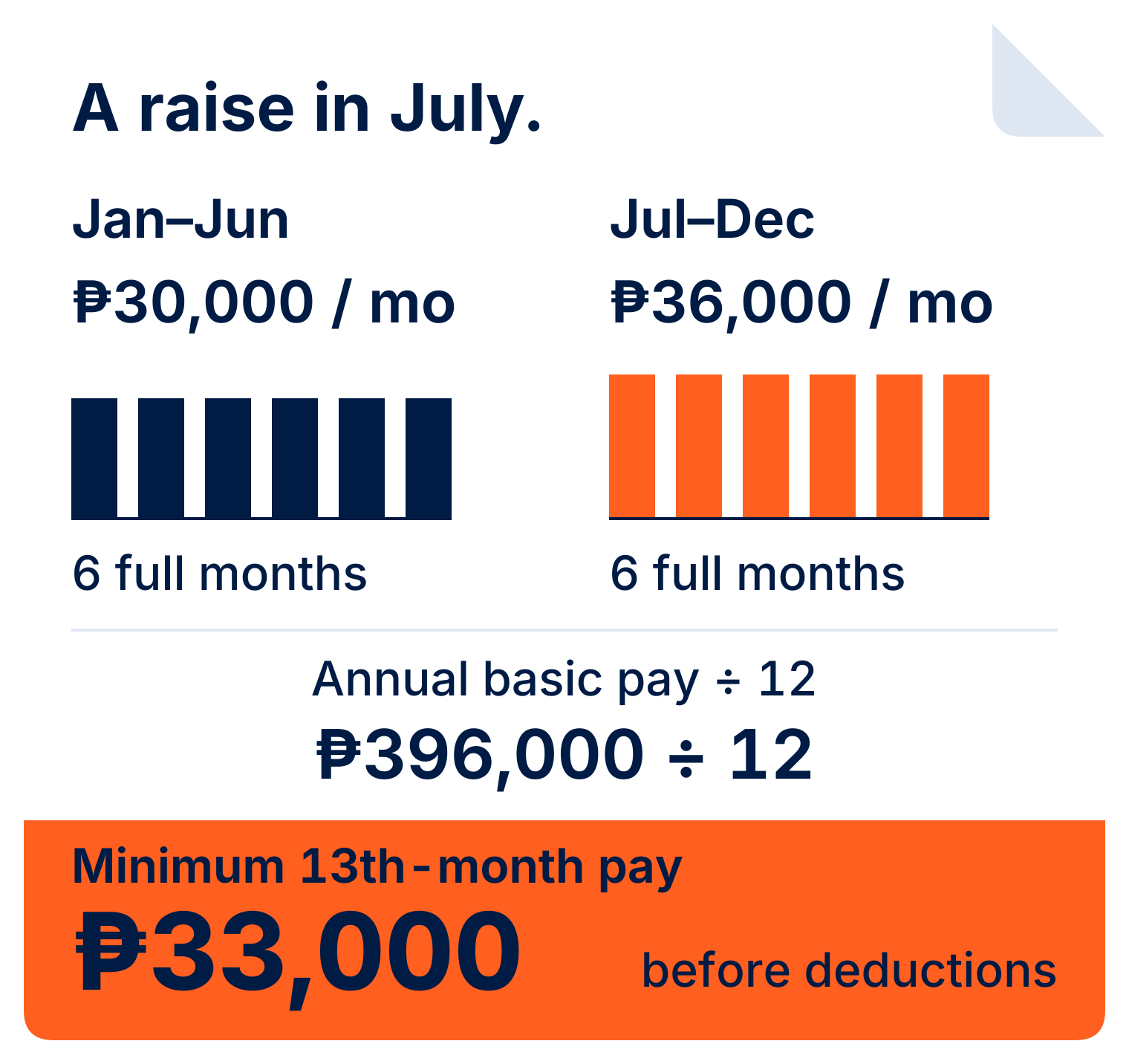
A raise from ₱30,000 to ₱36,000 in July gives ₱33,000 in minimum 13th-month pay before deductions in this example. The calculation uses the basic pay earned across the full year.

Illustrative pay examples · sources and arithmetic checked 13 October 2026.
Reviewed by Cherry De Vega, Bookkeeping and Compliance Reviewer.

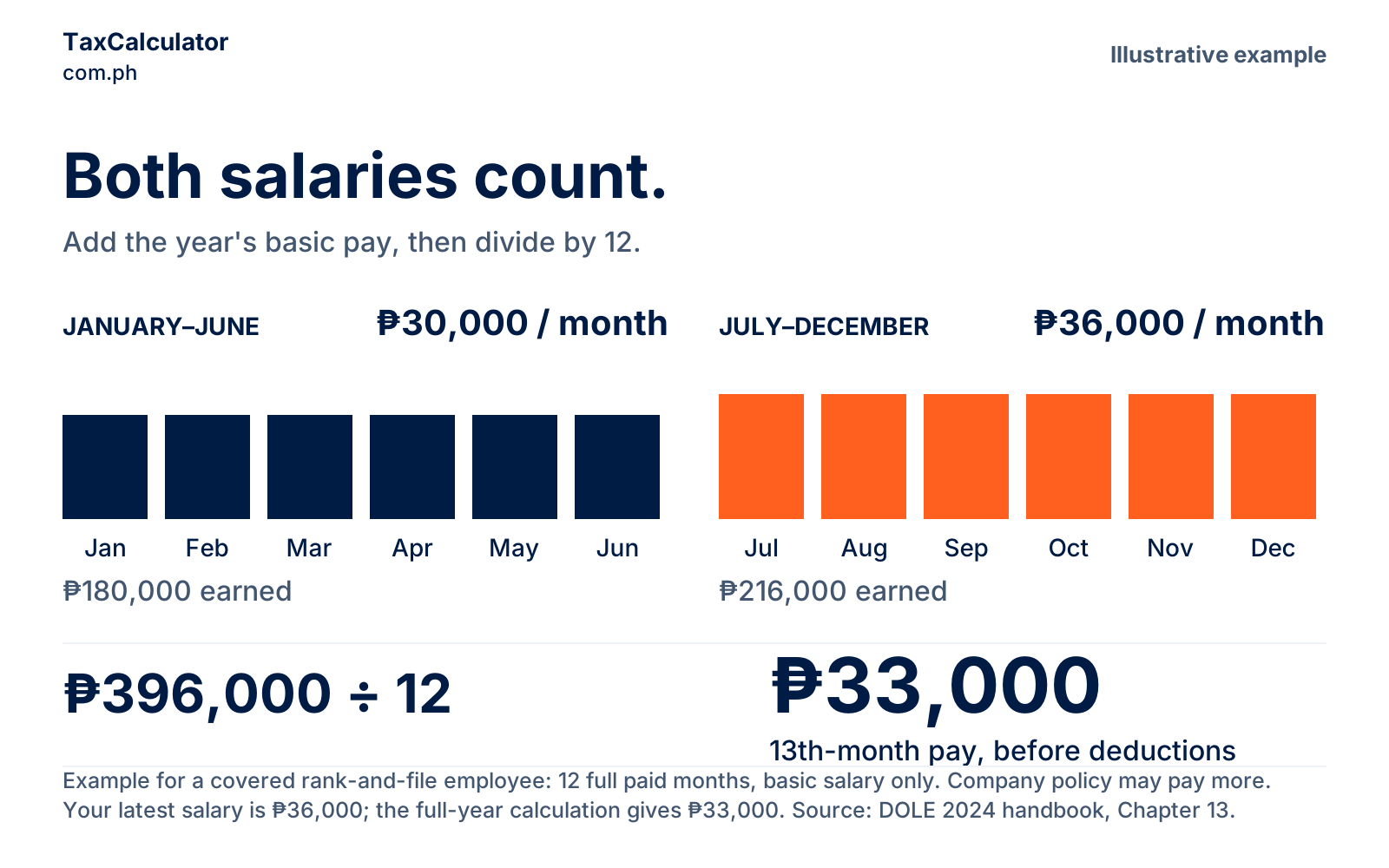
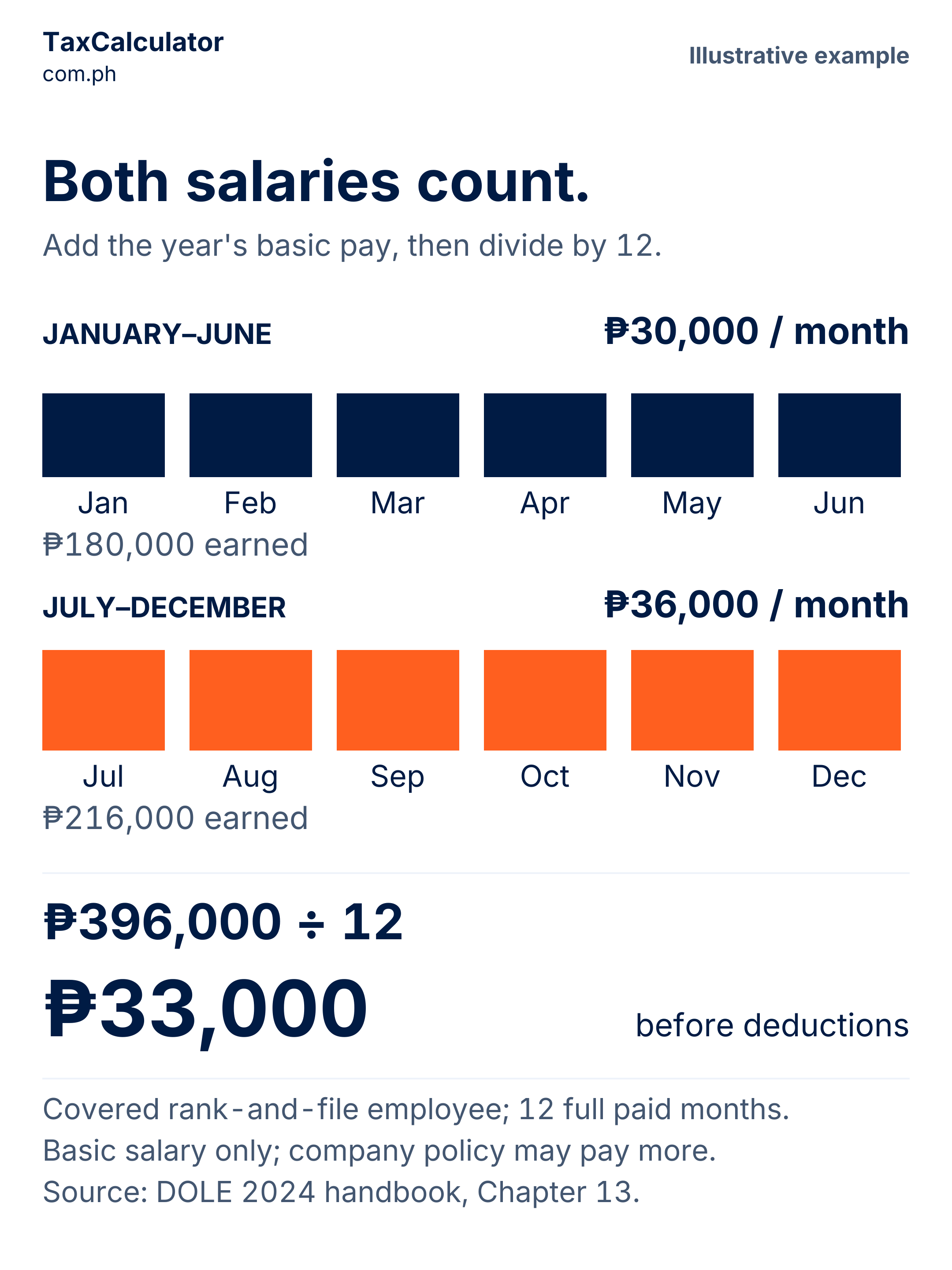
Salary-history example: six months at ₱30,000, then six at ₱36,000. The year’s basic pay totals ₱396,000; dividing by 12 gives ₱33,000 in 13th-month pay before deductions.
Salary-history example: twelve full paid months for a covered rank-and-file employee. Company policy may pay more. DOLE, Chapter 13

Which calculation do you want to check?

The full year gives ₱33,000 in 13th-month pay.

The latest monthly salary is ₱36,000. The annual benefit also counts the six months at ₱30,000 before the raise.

Latest salary and minimum 13th-month payExample with twelve full paid months · before deductions
Latest salary and minimum 13th-month pay
Amount in this examplePesos
Latest monthly basic salary₱36,000
Minimum 13th-month pay₱33,000
Difference between these amounts₱3,000

Covered private-sector rank-and-file employee; twelve full paid months at the listed basic salary. This is the legal minimum calculation. A company policy or agreement may pay more.

DOLE handbook, Chapter 13

The year’s basic pay totals ₱396,000.

Six months at ₱30,000 contribute ₱180,000. The next six at ₱36,000 contribute ₱216,000. Add them, then divide the total by 12.

Six months at each salary give ₱33,000 in 13th-month pay
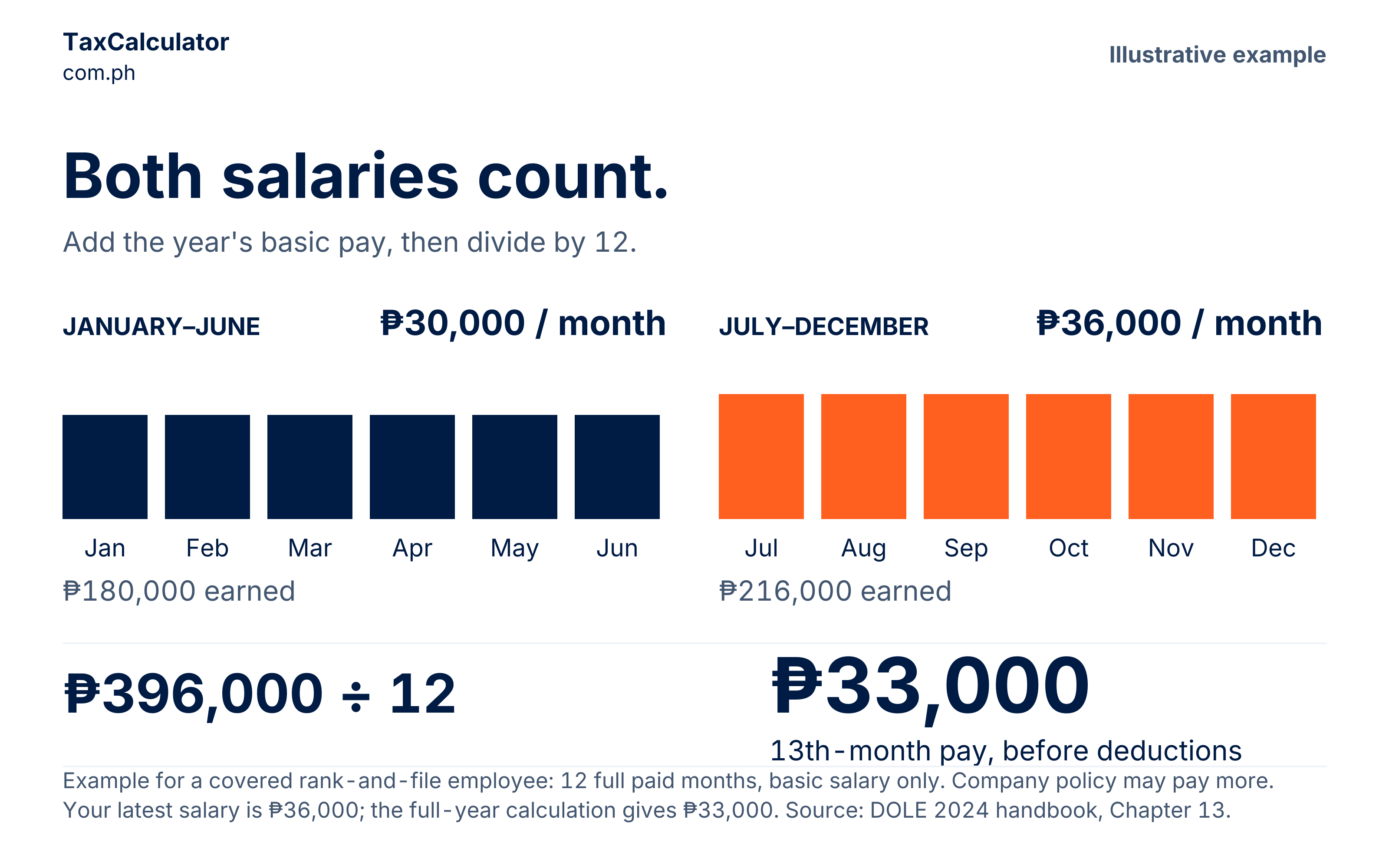
Six months at 30,000 pesos and six at 36,000 total 396,000 pesos of basic pay. Divide by 12 for 33,000 pesos of 13th-month pay before deductions.

This employee earns ₱30,000 in basic pay for six full months and ₱36,000 for the next six. The year’s total is ₱396,000. Dividing by 12 gives ₱33,000 before deductions. This is the minimum calculation for a covered private-sector rank-and-file employee; a company policy or agreement may pay more.

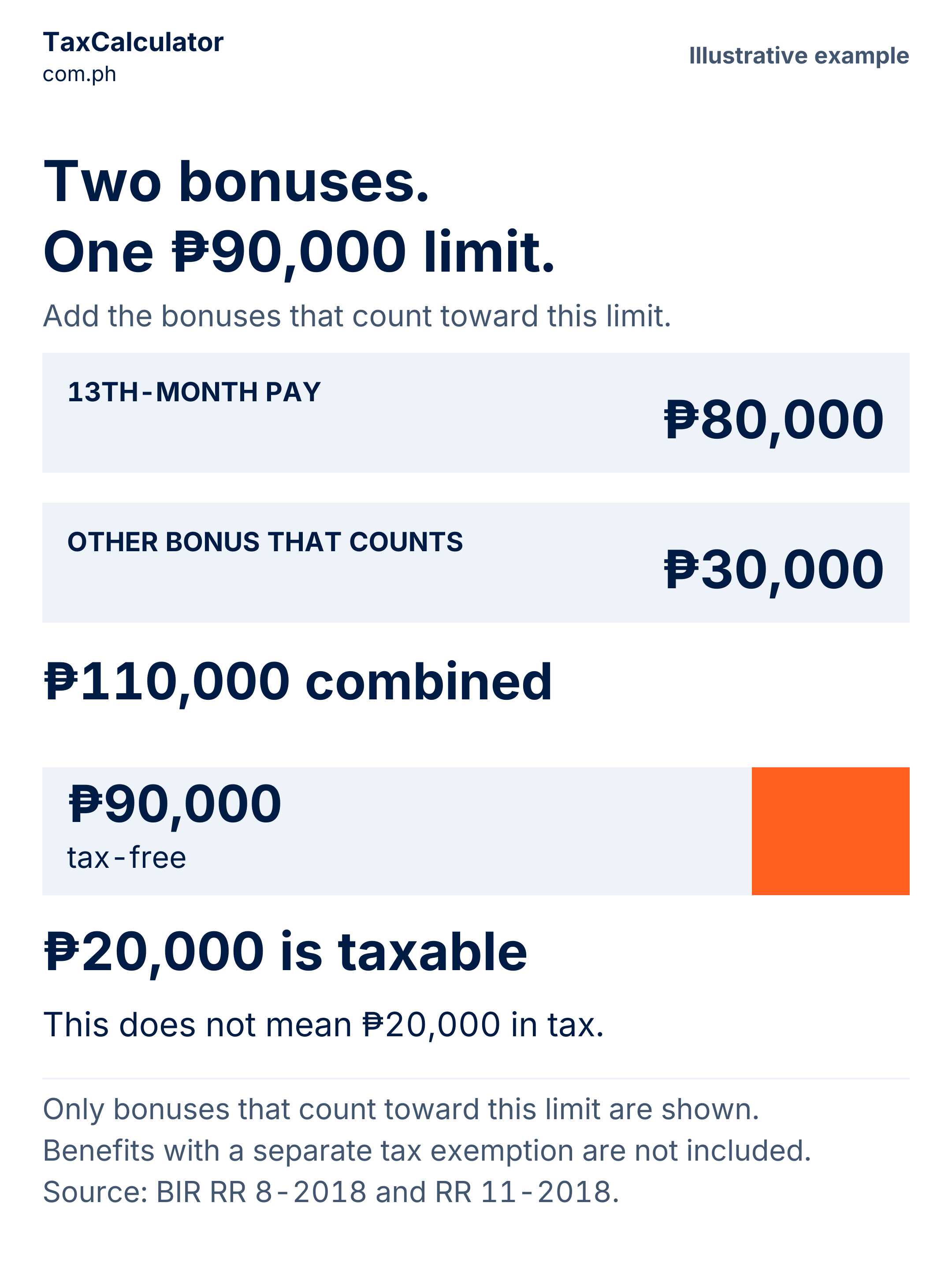
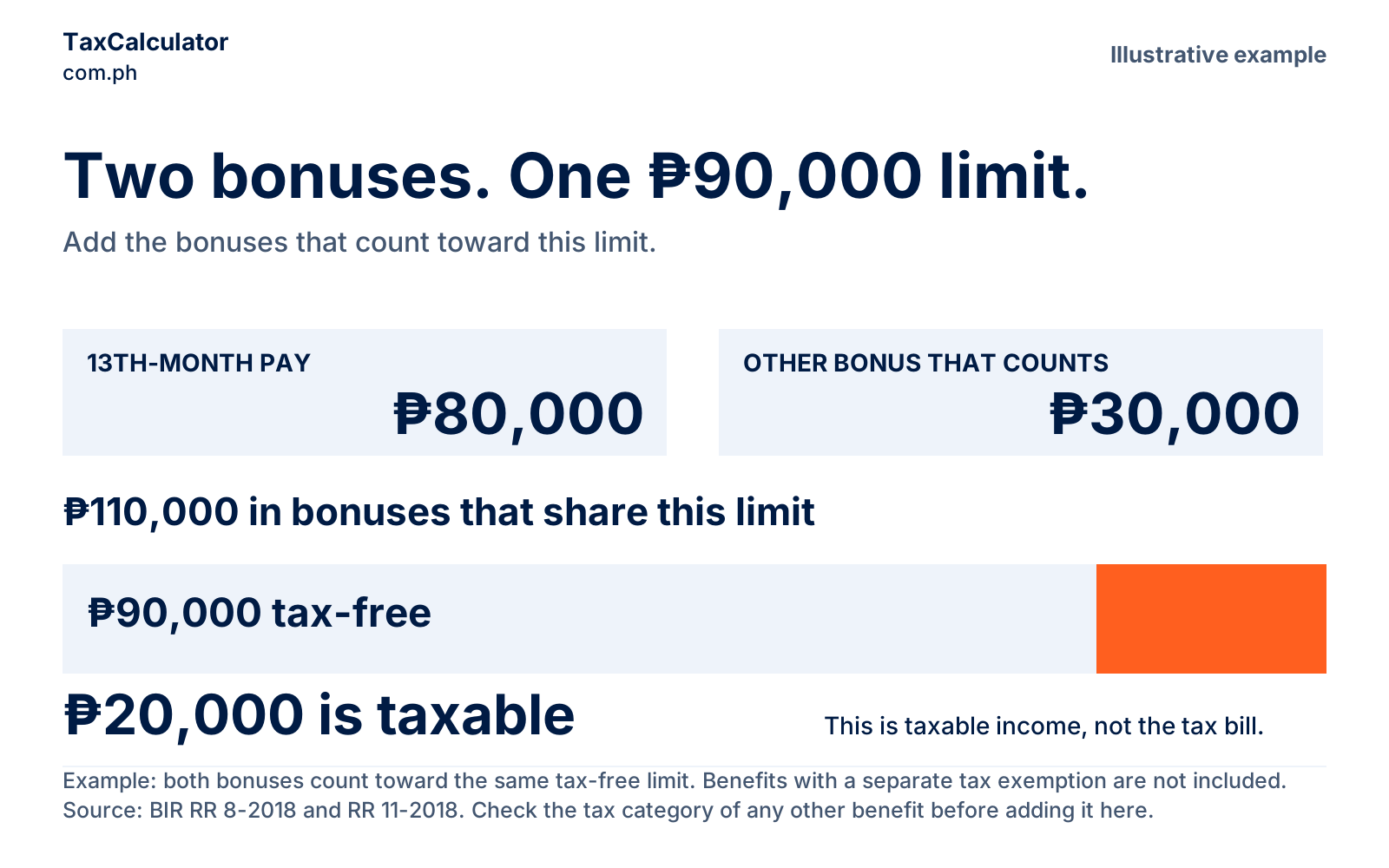
Both eligible bonuses count toward the same ₱90,000 limit.

Here, ₱80,000 of 13th-month pay and an eligible ₱30,000 bonus total ₱110,000. The ₱20,000 above the limit is added to taxable income; it is not a ₱20,000 tax bill.

The two eligible bonuses leave ₱20,000 above the shared limit
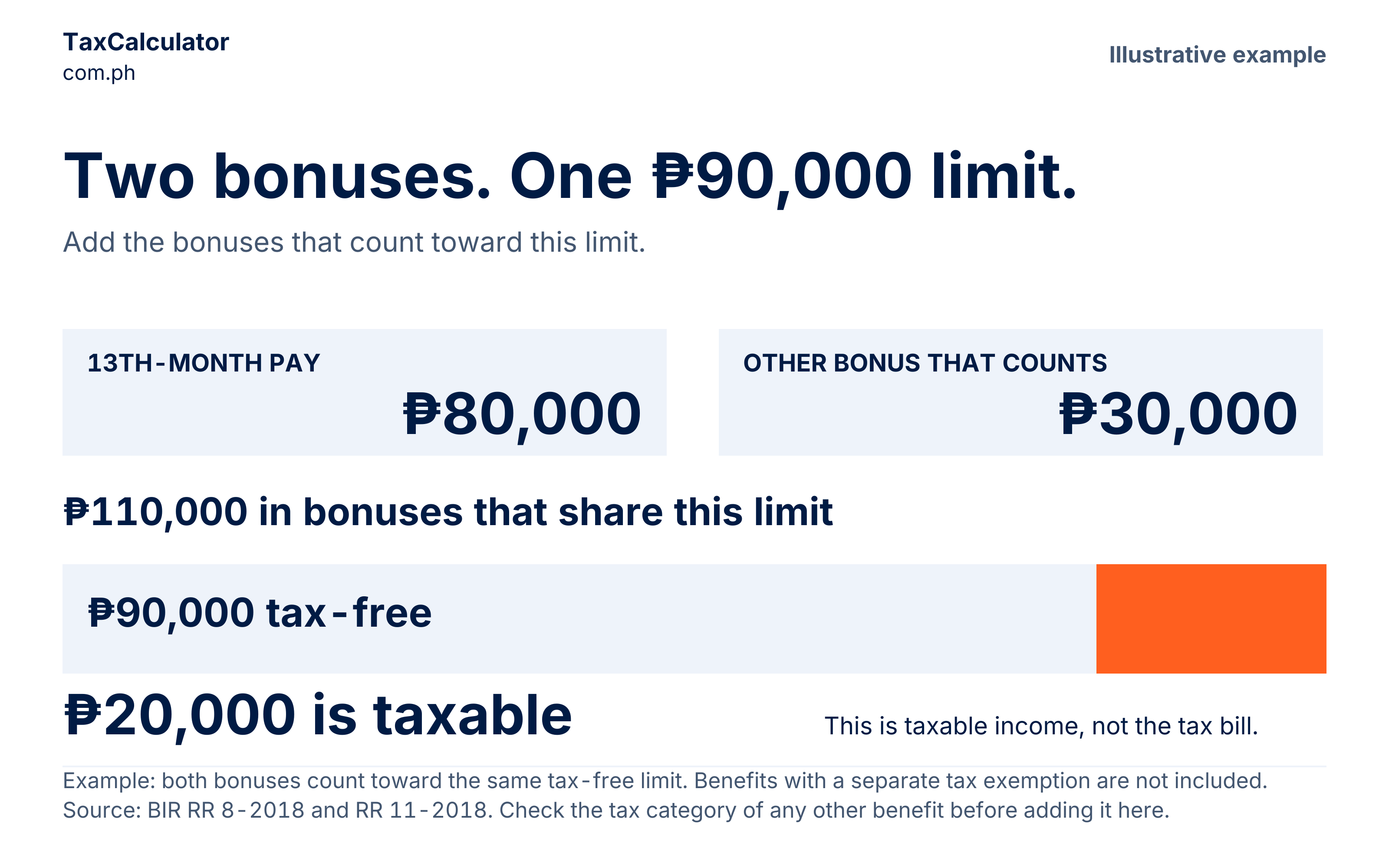
80,000 pesos of 13th-month pay plus another eligible 30,000-peso bonus total 110,000. Of that, 90,000 is tax-free and 20,000 is added to taxable income, not owed as tax.

Here, ₱80,000 of 13th-month pay and another eligible ₱30,000 bonus share the same annual ₱90,000 tax-free limit. Their total is ₱110,000, so ₱20,000 is added to taxable income. It does not mean ₱20,000 in tax. Some benefits have separate tax exemptions; those are outside this example.
To check your own amount, add the basic pay you earned this year and enter that total in the calculator.

Calculate your 13th-month pay

Download the files for your article.

The pack includes all three diagrams in wide and portrait versions, editable SVGs, and the two calculation tables. Each calculation lists its inputs, assumptions and sources.

Download all graphics and calculations

Credit: TaxCalculator.com.ph. Keep each graphic’s assumptions and sources visible. These are constructed examples, not employee payslips. The pack contains six PNG diagrams, six SVG files and both calculation tables.

Reviewed by: Cherry De Vega, Bookkeeping and Compliance Reviewer. Official documents are linked below and are not included in the download. Read the credit and source notes.

Questions about an example?

Contact Aditya Aman at TaxCalculator.com.ph for a calculation breakdown or a different image format. Reviewed by Cherry De Vega, Bookkeeping and Compliance Reviewer.

Email Aditya Aman

DOLE and BIR sources